Aphasia takes your words. It does not take your mind.
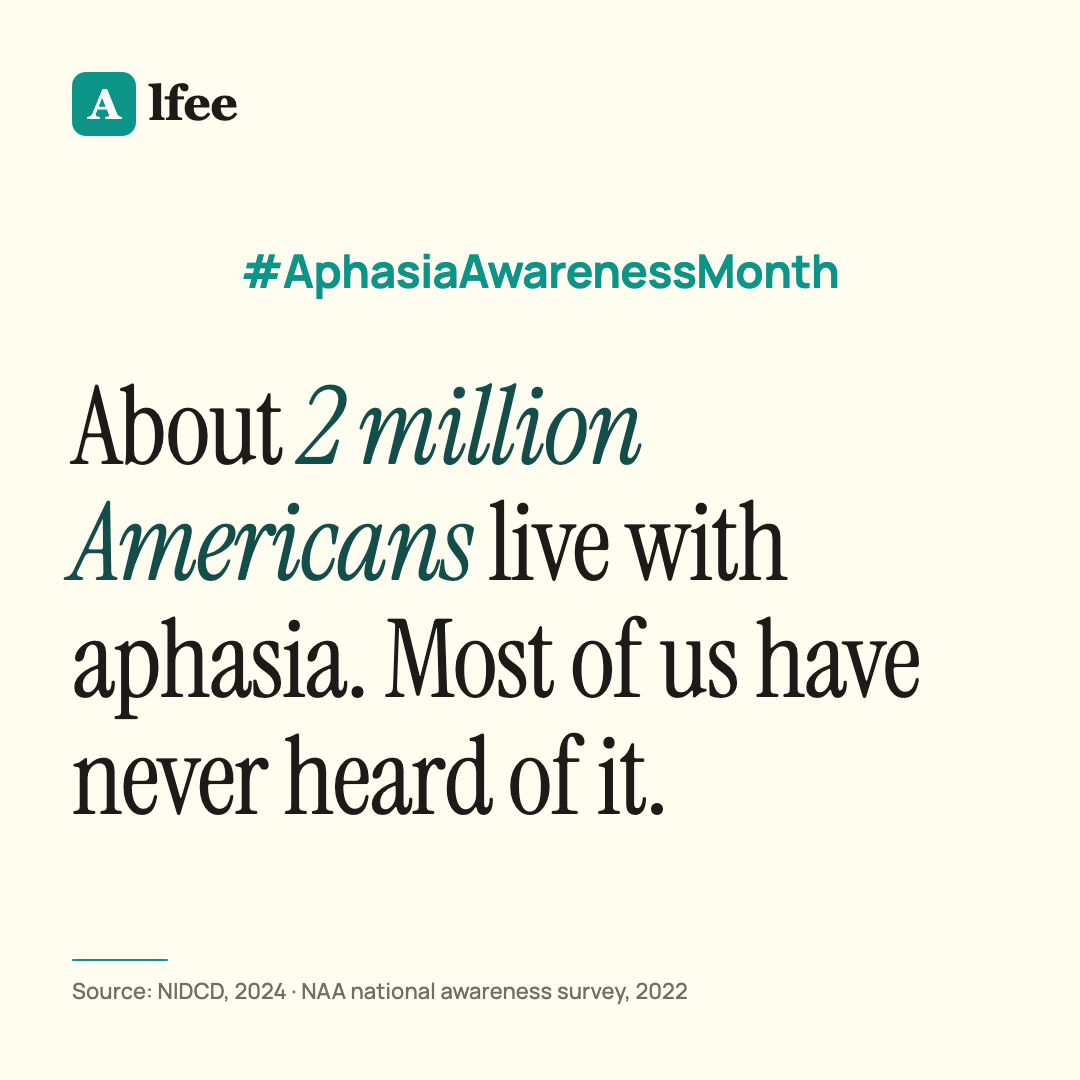
Each June, aphasia gets a month of attention. The rest of the year, most people still don't know the word. This page is a small contribution — a few facts worth knowing, free practice you can hand to someone today, and the organisations to learn from next.
Forward this page to anyone you'd like to understand a little more.
A 30-second glimpse
Here is a small window into one experience — word-finding difficulty, called anomia. Not a survey of all aphasia. Skippable at any time.
About 30 seconds. You can skip at any time.
That gap is anomia.
Knowing the word, struggling to retrieve it. For most people with aphasia, this happens with familiar words many times a day — sometimes it resolves in seconds, sometimes it doesn't resolve at all.
Source: National Aphasia Association — about 1 in 3 stroke survivors lives with aphasia.
Worth knowing
Three numbers, three sources.
Stroke survivors develop aphasia. Someone in the U.S. has a stroke every 40 seconds.
Source: CDC, 2024 · NIDCD
Recovery can keep going long past the six-month mark people are often told to expect.
Source: NIDCD aphasia overview
Free practice
Something you can open today.
Three short, calm exercises. No accounts, no streaks, no scores. Free, in your browser or on your phone — open it for someone you love.
Read the Word
Practice reading simple words with audio support.
Open the game →Word Recognition
Listen and choose the correct word from options.
Open the game →Object to Word Match
Match the object icon to the correct word.
Open the game →Also on iPhone
Same three exercises, on the phone next to you.

Go deeper
The organisations that have been doing this work.
Alfee is a small free tool. These are the people who research, advocate, and resource the broader aphasia community.
National Aphasia Association
aphasia.orgU.S. advocacy and awareness — the home of Aphasia Awareness Month.
NIDCD (NIH)
nidcd.nih.govFederal research and plain-language health information.
ASHA
asha.orgThe professional body for speech-language pathologists.
Aphasia Access
aphasiaaccess.orgLife-participation approach to aphasia for clinicians and families.
Alfee is built by a family member of someone with aphasia. It's free, it's quiet, and it isn't a substitute for working with a speech-language pathologist. If you find something that could be better — a word, a picture, a feature, a language — please write.